What Investors Look for in Your Talent Strategy Before They Write the Cheque
Most founders walk into fundraising conversations ready to talk about product, market size, and revenue projections. Very few walk in ready to talk about how they plan to build the team that will deliver on all of it.
That is a mistake. And it is one I have seen cost founders term sheets, valuation leverage, and in some cases entire rounds.
Over 25 years of working with tech and space companies from pre-revenue through to valuations north of $6 billion, I have watched the investor lens shift significantly. Talent used to be an afterthought in due diligence.
Something that came up in passing during a reference call or a casual question about the org chart. Today it is a core evaluation criterion, and the founders who understand that have a material advantage when they sit down at the table.
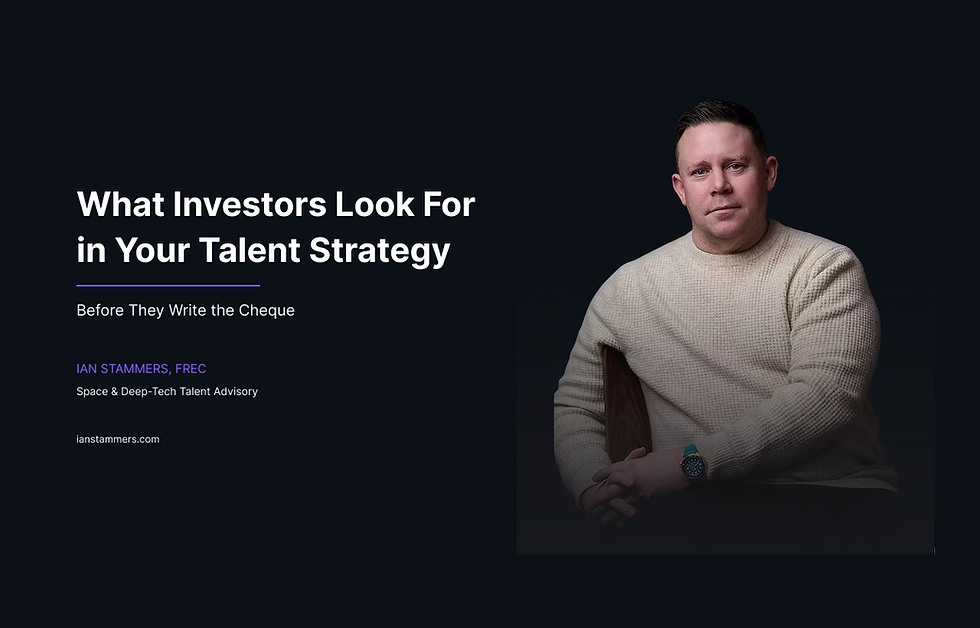
Why Investors Assess Your Hiring Plan Before Funding
Venture capital is a bet on people. Every experienced investor knows this, and the data backs it up. Industry research consistently shows that the majority of VC-backed failures trace back to team and leadership issues rather than product or market problems.
At Series A, investors are looking beyond the founding team and asking a harder question. Can this company attract and retain the people it needs to execute at scale? A strong product roadmap means nothing if you cannot hire the engineers to build it. A go-to-market plan falls apart without the commercial team to run it. A compelling TAM slide loses credibility when there is no talent strategy underneath it.
This is especially true in deep tech and space, where the talent pool is shallow and the competition for experienced professionals is intense. If you are building satellite hardware or propulsion systems and your plan for hiring the next 15 engineers is "we will post on LinkedIn," investors will notice. And they will worry.
What VC Due Diligence on Talent Actually Looks Like
Due diligence on talent has become significantly more structured in recent years. At the seed stage, investors are mostly evaluating the founders themselves. Their backgrounds, domain expertise, resilience, and ability to communicate a vision clearly enough to attract other people to the mission.
By Series A and beyond, the scrutiny widens. Investors want to understand several things about your people strategy, and they want evidence rather than ambition.
The first is team composition. Who is already in the building, and what gaps exist? Investors map your current team against what the business needs over the next 12 to 18 months. If you have a CTO but no engineering managers, or a founding team of three technical co-founders with no commercial capability, that gap registers as execution risk.
The second is your ability to recruit top talent. Have you already demonstrated that you can attract strong people? The quality of your first 10 to 20 hires tells investors a lot about the culture you are building and the calibre of network you can access. A track record of strong hires is one of the most compelling signals a founder can present.
The third is process maturity. Do you have a structured approach to hiring, or does every role start from scratch? Investors at the growth stage increasingly look for documented hiring frameworks, interview processes, and onboarding systems. Not because they expect a 30-person company to have a full HR department, but because repeatable systems indicate operational discipline.
The fourth is retention. If you have hired well but people are leaving within 12 months, that tells a different story. Retention data, even informal data at the early stage, is a signal of organisational health that investors pay close attention to.
How Your Talent Strategy Signals Startup Readiness for Series A and Beyond
There is a difference between having a plan to hire and having a talent strategy. The plan says "we need four engineers and a VP Sales in the next two quarters." The strategy says "here is how we scope roles, where we source candidates, how we evaluate them, what our offer framework looks like, and how we onboard and retain them."
Founders who can articulate a talent strategy at this level are doing something important. They are demonstrating that they have thought about scaling the organisation with the same rigour they apply to scaling the product.
This matters even more in capital-efficient environments. In 2026, investors are more disciplined than they have been in years. The era of funding growth at all costs has been replaced by a focus on unit economics, operational efficiency, and sustainable scaling. A well-defined talent strategy fits squarely into that picture because it reduces the cost of mis-hires, shortens time-to-productivity for new joiners, and gives the board confidence that headcount growth will translate into value creation rather than just burn.
For PE-backed companies or those heading toward later rounds and IPO preparation, the bar is even higher. Governance readiness includes organisational design, succession planning, and documented people processes. Investors at this stage are not just asking "can you hire?" They are asking "have you built a company that can scale its people function independently of the founders?"
Building an Investor Talent Strategy Without a Full-Time Head of Talent or CPO
This is where most founders between Seed and Series C get stuck. They understand that talent strategy matters, but they are too early to justify a full-time CPO or Head of Talent. The budget is better spent on engineering, product, or commercial roles that directly drive the next milestone. The answer is not to ignore it.
The answer is to build the foundational elements so they exist when investors ask.
A Talent Playbook is one of the most effective tools for this. It documents your hiring process end to end. Role scoping templates, interview frameworks, competency maps, scorecards, and decision criteria. You build it once with expert input, refine it as you grow, and use it every time a role opens. When an investor asks "how do you hire?" you hand them the playbook instead of improvising an answer.
Market mapping is another component that investors value. Knowing who the key talent pools are in your sector, where your competitors are hiring from, what compensation looks like at each level, and which candidates might be approachable in six to twelve months. This kind of intelligence signals that you are not waiting until a role is urgent to start thinking about who will fill it.
Workforce planning rounds out the picture. A simple model that maps headcount growth to business milestones, broken down by function and quarter, shows investors that you have connected your people plan to your financial plan. It does not need to be complex. It needs to be thoughtful.
How a Talent Advisory Partner Strengthens Your Position Before Fundraising
I have worked with founders across six continents, helping them build the talent strategies that underpin successful fundraises, rapid scaling, and long-term organisational health. From early partnerships with companies linked to ESA and EUSPA through to startups that grew from a handful of engineers to hundreds of employees on their way to IPO, the pattern is consistent. The companies that treat talent as a strategic function rather than an administrative one raise better, scale faster, and retain the people who got them there.
If you are preparing for a fundraise and want to make sure your talent strategy stands up to investor scrutiny, I would welcome a conversation. Whether that means building a Talent Playbook, mapping your workforce plan against your funding milestones, or simply pressure-testing your hiring approach before you walk into the room, I am here to help.
Reach out at hello@ianstammers.com or book a call through the contact page.


Comments